
Previous Morning Discussions
Latest2023: Apr
2021: Jan / Apr / Jun / Nov
2021: Jan / Feb
2020: Jan / Sep
2019: Oct
2017: Jan / Mar / Apr / Sep / Oct
2016: Jan / Mar / Apr / May / Sep / Nov
2015: Jan / Feb / Mar / Apr / May / Sept / Oct / Nov
2014: Jan / Mar / Apr / May / Sept / Oct / Nov 2013: Jan / Mar / May / Oct / Nov
2012: Jan / Feb / Mar / Apr / May / Oct / Dec
2011: Jan / Mar / Apr / May / Oct / Nov
2010: Jan / Feb / Mar / May / Sep / Oct / Nov
2009: Jan / Feb / Mar / Apr / May / Sep / Oct / Nov
2008: Feb / Mar / May / Oct / Nov
2007: Jan / Feb / Apr / Jun / Oct
2006: Jan / Feb / Mar / Sep / Oct / Nov
2005: Jan / Feb / Mar / Dec
2004: Mar
2003: Feb / Mar
2002: Jan / Feb / Mar / Apr / May / Oct / Nov
2001: Jan / Feb / Mar / Apr / May / Sep / Nov
2000: Oct / Nov
April 13, 2023
“StackDX Demo with PetroNinja Mapping Software and Edith, their Artificial Intelligence”
|
This presentation will be a great refresher for those currently using StackDX or are thinking of using the software, and for those who don't know about StackDX and would like to see what it can do for you. With StackDX you can:
|
March 23, 2022
EMS - “Limitation Periods in the Oil and Gas Industry”
|
Robert Martz and Paul Chiswell of Burnet Duckworth & Palmer LLP will give a legal overview of Alberta's Limitations Act as it applies in the oil and gas industry and address questions. What is the time limit to bring a claim? The Limitations Act sets the time limit when the "books are closed", although many JV agreements extend the time limit. How is the industry handling "leftover" items, including forgotten invoices, stale invoices, discovery of a systemic error, uncompleted 13th month adjustments, and unresolved audit queries?
|


November 25, 2021
EMS – Fireside Chat & AGM
|
The AGM will be followed by a Fireside Chat which will focus be on developing strategies to:
|
June 17, 2021
Acquisitions and Dispositions and issuing Mail Ballots for Change of Operatorship
PJVA will be hosting a discussion on the Change of Operatorship as a result of an Acquisition & Dispostion transaction. The following issues will be presented, followed by an open discussion by participants:
- Does Seller (as former Operator) have the right to even issue the mail ballot as they are no longer considered an Owner
- If Seller issues Mail Ballot, do they include the new Owner as an Owner and does the new Owner have the right vote to elect itself as the new Operator?
- Is the Purchaser automatically the interim Operator be virtue of being the Owner with the next highest WIO? While waiting for the official vote?
April 28, 2021
New PJVA Model CO&O is about to be released to industry
Please join us on April 28, 2021 from 9:00 am to 10:30 am as the CO&O Task Force facilitates a discussion and answers your questions on the most important changes made in Draft 2 of the CO&O. Don't miss this opportunity to raise your questions and get any clarification you may need before the comment deadline, which has been extended to May 15, 2021. Your input on Draft 2 is the final opportunity to contribute to the Model CO&O prior to its release to industry. We encourage you to review Draft 2 before the session. Please visit the PJVA website to access the documents.
Session Facilitators/Task Force Members:
- Tim Reimer
- Ib Moller
- Crawford Hutchinson
- Lynda MacNeill
And will be hosted by PJVA EMS Director: Doug Klug
February 25, 2021
Discussion on Alberta Crown Request to remove struck companies from Units - Ramifications, Liabilities, Issues
Unit Operators have recently been in receipt of requests from the Alberta Department of Energy (DOE) to remove struck companies from tracts in Unit Agreements. This request seems fairly straightforward, but the more you dive into it, the more complex it becomes.
- What happens to the struck company's interest?
- How does the Unit Operator preserve the Units rights to submit claims to the Orphan Well Association (OWA) for the struck company's interest?
- Does it make sense to remove the struck company's tracts or do you sign a new Lease?
- Who is responsible for the struck parties Mineral Rentals and Royalties in arrears?
- Did the struck company pay lease rentals and keep the leases and tracts viable?
- Do you simply gross up the remaining partner's interests?
- Is there a tract partner in that tract that could pick up the struck company's interest?
- What if there is a producing well on the struck company's tract?
- Is the Operator forced to abandon the well prematurely as a result?
January 27, 2021
Model CO&O Agreement — Industry Draft 2 Available for Comment
PJVA presents Draft #2 of the Model CO&O for membership review and comment. Draft #2 has incorporated some changes as a result of industry comments on Draft #1.
As our Model Agreements are one of our key pillars, the PJVA was seeking membership feedback on this latest draft to ensure the following:
- This model addresses current industry needs; and
- This model would be an acceptable and most importantly adopted model for use by industry.
The purpose of the session was open discussion on the Model CO&O and to hear any and all comments, concerns, and suggestions.
September 30, 2020
The Canada Emergency Wage Subsidy (CEWS)
In March of this year, the Federal Government introduced the Canada Emergency Wage Subsidy (CEWS) to help employers re-hire workers, and help prevent further job losses. What this means is companies can apply for and may be eligible for a subsidy to cover part of their employee wages.
The question for us in the Joint Venture world is:
Should the Operator be required to pass these subsidies on to their partners in Joint Operations?
Other issues are:
- Is the Operator responsible for notifying their partners that they have applied for and received subsidies for employees charged to the joint operations.
- Does the Operator have a responsibility to apply for this subsidy since there are potential cost savings to the Joint Operations?
- Do the various current industry agreements, and related Accounting Procedure, address this?
January 22, 2020
CAPL/PJVA Pad Site Sharing Agreement
The CAPL/PJVA model Pad Site Sharing Agreement (PSSA) was released in the fall of 2018. Its purpose is to be the governing agreement for multi-well pad sites containing wells with different ownership sets and which may be governed by separate land agreements. The structure of the PSSA document is similar to the PJVA model Construction, Ownership and Operating Agreement (CO&O) and the text is a blend of CAPL Operating Procedure and PJVA CO&O language.
A one-day PSSA seminar was conducted on June 5, 2019 and was well attended. A second seminar is being planned for March 4, 2020. The purpose of this Early Morning Discussion is to gauge the degree to which the agreement is being used and to discuss successes and challenges.
How many companies are using or intend to use the agreement?
For those who have used it:
- Has it been easy or difficult to use?
- Have the parties to the agreements executed them without substantial changes to the content?
- Have there been any recurring challenges associated with negotiating and finalizing the agreements?
- Are companies applying the PSSA to previously drilled pads containing wells with different ownership sets?
October 30, 2019
Firm Service Contracts — Who should pay for underutilized service?
Presentation and discussion of some of the current issues that arise with non take-in-kind volumes.
Norbert Czypionka, Manager — Production and Revenue Audits at Joint Venture Strategic Advisors (JVSA) will start the discussion with a presentation of some of the issues that arise from production and revenue audits.
March, 2017
Special Edition EMS — Lunch & Learn style
Charging fees for Processing and Transportation — Land or JV?
What if you, as a JV professional, were approached by a company advising that for the purposes of reducing their administrative costs, that their joint venture agreements were going to be terminated and in place thereof, charges for things such as facility processing and transportation would fall to the land contracts? It’s one thing to terminate existing agreements but another to do so without establishing clear contractual terms to replace them.
As JV professionals, we know that a contract must be a mutual agreement between the parties and one party cannot unilaterally impose new terms with no way for the other party to accept them. Further, holes exist in the various CAPL agreements and it is for that reason (and others) that joint venture contracts and the joint venture industry were developed many decades ago. Land contracts such as JOAs cannot apply to multi-well facilities while serving different ownership groups, hence the need for individual service agreements when dealing with diverse working interests. In addition, key business terms such as billing and payment, product specifications, acceptance and delivery of production, allocations, priority, and failure to take in kind would be missing, as well as key provisions such as limitations, notices, audit rights, default and confidentiality. Omissions like this create uncertainty and only add risk.
October 25, 2017
Quit Claim Provisions
This topic will be presented by George Lepine from Enernext which is a boutique legal and advisory platform focused on energy, cleantech, sustainability, environmental compliance, liability and risk management and strategic planning.
September 27, 2017
Mutual Consent — Which agreements and clauses does it apply to?
Kyla Ulmer from ARC Resources will be presenting this topic, focusing on the importance for Joint Venture Contracts Analysts/Administrators on verifying terms of agreements. The topic of discussion will pertain to service Agreements, revisions of exhibits and dispositions and what current industry standards and practices are in place.
April 26, 2017
2017 CAPL Property Transfer Procedure
CAPL issued the second draft of the update to the 2000 CAPL Property Transfer Procedure in late January. The third draft will be presented to industry for review in late spring, and CAPL endorsement is expected in October. PJVA is represented directly on the Committee by Paul de Villenfagne as the PJVA Liaison.
Presentation:Please login to download the presentation
Also here is the hyperlink to the Draft 2 Property Transfer Procedure materials on the CAPL website.
March 29, 2017
Taking Action for Canada's Future
Founder and spokesperson for Canada Action Coalition, Cody Battershill presented to us on March 29, 2017
Cody Battershill is a Calgary Realtor who has been called a one-man oil and gas advocate by the National Post. Tired of the misinformation and vitriol directed at Canada’s resource industries, Battershill founded the Canada Action Coalition in 2010. Since that time, the organization has become one of the leading resource advocacy groups in the country, with online and offline reach in the millions and plenty of earned media attention from coast to coast.
Presentation:Please login to download the presentation
January 25, 2017
Stay in Control – Appropriate Dispute Resolution for Industry
Join us for this update on the issues, options, and provisions for the upstream Canadian petroleum industry. Engage in a conversation on the options for dispute resolution, the tools available and the proposed 2017 Dispute Resolution provisions for upcoming PJVA industry precedent agreements, including the new PJVA CO&O Agreement.
Presentation:Please login to download the presentation
November 30, 2016
Risky Business – Protecting Against Counterparty Default and Insolvency Risk
A session on risky business practices by Carole Hunter, helping you to identify counterparties with potential financial difficulties and ways to mitigate your risk.
Presentation:Please login to download the presentation
September 27, 2016
Facilities 101
Rein Evelein provides an overview on his Introduction to Facilities course. Rein presents a small sample of the course material and discuss how it is geared towards providing an in depth look at both oil and gas facilities for individuals with non-engineering backgrounds.
May 25, 2016
CO&O Update Part 4 – Pulse Check on Enlargements
The PJVA CO&O Task Force will be hosting a discussion on changes to a Facility over its life. Bring your questions, concerns and opinions on what’s working and what’s not. Let us know how you handle changes such as facility enlargements, operational changes, facility reductions, etc. Have your say and let's see how the proposed changes measure up!
Presentation:Please login to download the presentation
April 27, 2016
CO&O Update Part 3 – Pulse Check on Capacity
The PJVA CO&O Task Force will be hosting a discussion on capacity. Bring your issues, concerns, and pet peeves. Have your say — weigh in on what's working and what's not on all things related to capacity. Let's see how the proposed changes measure up!
Presentation:Please login to download the presentation
March 30, 2016
CO&O Update Part 2 – Specifications, Measurement & Allocation
This session on the new CO&O model will discuss Appendices 7, 8 and 9: Specifications, Measurement and Allocation. Many disputes arise from the improper application or lack of clarity and understanding of the inlet specifications and the application of allocation programs.
Presentation:Please login to download the presentation
January 27, 2016
CO&O Update Part 1 – Task Force Update
Members of the CO&O Task Force will provide an overview of some of the proposed revisions to the model CO&O. The focus of this session will be on the financial matters contained in the CO&O Agreement. This session will consist of an overview of proposed changes to the CO&O Agreement and will provide an opportunity for feedback and discussion on the topic.
Presentation:Please login to download the presentation
November 25, 2015
Back Out Fees
Moller and Keith Brereton will moderate the session and discuss what options an Operator of a facility has if third party production will back-out existing production? How do you determine shut-in compensation amounts if a competitor wants to drill a well through a producing zone to reach a deeper formation? What if production from one zone is stopped while the well is being serviced? Should the other company have to shut in their well to minimize impacts to the production? How should they be compensated if this is required? Have there been agreements in place in the past that have addressed these types of situations?
Presentation:Please login to download the presentation
October 28, 2015
The New War on Talent
In recent years, there have been a number of rule changes that have redefined what contractors are into a number of separate groups. Our presentation will address these changes and how they affect independent contractors and companies who work with them. This will provide insight as to the risks and liabilities to both employers and contractors. We will also discuss what strategies can be used by progressive organizations and contractors.
If you are a contractor or considering becoming an independent contractor as a result of recent retirement or due to this economic environment, this session will be beneficial to you. Come with your questions.
The presenter is CEO Aly Bandali, CHRP. Aly has almost 20 years of executive management experience in the field of human resources. He has worked as an HR strategist in a variety of sectors, including oil and gas, energy, engineering, aviation, municipal government, private enterprise and not-for-profit. Aly has been chairman of the Canadian Council of HR Associations, HR Institute of Alberta and HR Association of Calgary. He has also served on the HR Committee of the Chamber of Commerce and the Executive Education Committee at the University of Alberta.
Presentation:Please login to download the presentation
September 30, 2015
Emulsion Handling Fees
The topic for discussion at the September Early Morning Session was: What should the accepted industry practice be on determining Emulsion Handling Fees in a low price environment?
Presentation:Please login to download the presentation
May 27, 2015
The Art of Equalizations
The topic for discussion at the upcoming Early Morning Session will be on equalizations. Lorie Lindberg will be on hand to take us through the information and expertise needed to prepare an equalization and will speak to what we in JV need to look for in order to review and approve same. Lorie has worked in the oilpatch for a number of years in oil and gas production accounting. She has her CMA designation and has completed several certificate programs including CAPPA, Oil and Gas Auditing and teaching.
Lorie has taught for CAPPA for 25 years and has taught many years for PASC in the areas of Equalizations and Production and Revenue Accounting. Lorie has consulted for several companies for the past 19 years specializing in the areas of Equalizations and Gas Cost Allowance.
Presentation:Please login to download the presentation
April 29, 2015
A+D Issues from a JV Perspective
What are the various issues that could arise in an Acquisition or Divestiture? In what phase of the transaction (pre-close, close or post-close) might the issue occur? Does the existence of a governing JV agreement alleviate any issues? Finally and most importantly, what actions can the Joint Venture technician take to rectify the issue to the satisfaction of all parties involved?
Robyn Lewis (JV Specialist, Crescent Point Energy Corp.), and Lorie Caron, (Lead, Joint Interest Administration, Encana Services Company Ltd.), both possessing sufficient experience with A & D transactions during their years in joint venture, will moderate this session. The issues will be discussed with a view to sharing the cause and best resolutions. It is hoped that members will come to the session “armed” with their own issues and experiences to relate and discuss with the group.
March 25, 2015
Facilities 101 Course Status
Find out what's included, who's part of the team developing the course, how the course will be laid out and why there seems to be significant interest in the course. Course developer Rein Evelein and Board member Tracey Moore-Lewis will present and moderate the session.
February 25, 2015
Pad Sharing Agreement
Industry is drilling increasingly from shared well pads where wells or facilities are not held in common interests. This has created a need for an industry pad sharing agreement. How can the rights of the Operator and Joint Operators under the respective Joint Operating Agreements be balanced with the needs of the padsite Operator?
A joint PJVA-CAPL task force has accepted the challenge of developing a model well pad sharing agreement to strike such a balance. The agreement will govern the construction and operation of the shared site and shared facilities. It will raise awareness of, and bring clarity to the issues of Operatorship, liabilities and conduct of padsite operations. An industry standard model will speed the process of creating shared well pad agreements and offer parties the flexibility to customize for their own particular needs.
Task Force members Michael Bruch and Lorraine Grant will present and moderate on this topic.
Presentation:Please login to download the presentation
January 28, 2015
Our first Early Morning Session of the New Year will be held on Wednesday, January 28th. Esteemed members of the C.O. & O. Task Force will be "in the house" to update us on their progress with the new Model Construction, Ownership and Operation Agreement. Tim Reimer and Crawford Hutchinson will moderate the session with expert assistance from Lynda MacNeill and Jan McLean. The group will provide an overview of the changes made to the agreement and why it is taking longer than anticipated to complete the process. This is a session you won't want to miss!
Presentation:Please login to download the presentation
November 26, 2014
Budgets
- Are companies actually sending out annual budgets for a vote anymore?
- Is it really necessary to have budgets approved by partners or just sent for information purposes?
- Do we need budgets for all facilities and units, just the major ones or those facilities and units with high operating costs?
- How should the mechanics work? Are the current timelines in the agreement practical and achievable?
- What can we do if the operator doesn’t comply?
- Some Operators use the approval of the annual budget as blanket approval for the year for all of the maintenance projects mentioned in the budget documents, no matter how large the dollar value. Is this really legitimate?
Ib Moller, recently returned from warmer, sunnier climes, will moderate this “chilly” discussion.
November 3, 2014
Mr. Ove Ryland of Norway, Executive Director for EPIM (Exploration Production Information Management)
Mr. Ryland will discuss the background and history of the EPIM (Exploration Production Information Management) organization, challenges and the Norwegian regulatory/JV regime. Norway is considered one of the world’s most attractive E&P provinces, mainly because of their globally recognized best in class framework and reputation. Now, more than ever, the industry is pressured to reduce costs by leveraging best practices.
EPIM was established by the operators on the Norwegian Continental Shelf who identified a need to share information between operators and partners. Through this initiative L2S (License To Share) was created. Ove Ryland will share the story about how L2S has developed from its formation, through changes and regulatory reporting to becoming a global best practice solution for JV Management. He will shed light on the process, the challenges and opportunities through more than 10 years of its existence, and the role of EPIM going forward in establishing best practice solutions across the O&G industry. Since the birth of L2S, EPIM has identified 4 additional areas of expertise where the O&G industry can improve collaboration and information handling.
Ove Ryland, Executive Director, EPIM
years + in Amoco & BP, mainly in Major Development Projects, SCM & Operator’s Joint Venture Management arena, incl. integrated business planning. Been a part of O&G industry collaboration forums since 1999. Became chair of EPIM BoD in 2007 and Executive Director from 2008.October 29, 2014
Statute of Limitations
At the October 29th Early Morning Session, we will revisit The Limitations Act.
The Limitations Act sets the time limit when the “books are closed”, although many JV agreements extend the time limit. How is industry handling “leftover” items such as:
- Forgotten Invoices (Operator discovers it had not been invoicing)
- Discovery of a systemic error
- Uncompleted 13th Month Adjustments
- Unresolved audit queries:
- Claims that extend beyond the audit period
- Time to resolve audit queries
Julie Taylor and Paul Chiswell, solicitors with Burnet, Duckworth & Palmer LLP, will give a legal overview of Alberta’s Limitations Act and address questions.
Presentation:Please login to download the presentation
September 24, 2014
Emulsion & Water Handling Agreement
The PJVA Board of Directors would like to invite members to see, hear and experience the newly rolled out “Emulsion/Water Handling Agreement”. This is the latest agreement to be added to the PJVA suite of model agreements.
The members of the EWHA taskforce will present the agreement, and will discuss the process followed (over 5 years) to complete this model. Also discussed will be some of the more contentious clauses and issues which the taskforce worked through.
Task Force:
Deidre Garyk
Beth Swift-Hill
Tanis Kalynchuk (in a supporting role)
Marcel Savoie
May 28, 2014
TO CONSENT OR NOT TO CONSENT...THAT IS THE QUESTION
The primary topic for discussion at this week's EMS will be the assignment / consent provisions of the current PJVA model service agreements. We will discuss the wording of the clause and the reasons for requiring prior consent. What are the options of not granting consent and how vigorously should consents be followed-up on? This is a timely topic for discussion given the impending release of the new model Emulsion Handling Agreement where the consent provisions of the assignment clause have been removed.
April 30, 2014
Model Production Administration Service Agreement
By Jan McLeanThe Early Morning Session on Wednesday, April 30th introduced the new PJVA Model Production Administration Service Agreement - the most recent addition to the PJVA slate of model agreements. The presentation described the purpose of the agreement and when use of the agreement is appropriate. The terms of the agreement were explained and additional information provided regarding basic operations, identification of production sources and commonly misunderstood terms.
Jan McLean, long time PJVA member and recently recognized Lifetime Member, presented and moderated this session. Her vast knowledge and experience are well known to the industry. If you're new to the PJVA, you should check out Jan's bio on the website. Jan has been involved in the creation and maintenance of numerous model agreements. The session will be interesting and informative for all who attend.
Please login to download the presentation
March 26, 2014
A Recommended Practice for the Negotiation of Processing Fees
By Tim Reimer, Rick SteffensenPresentation:
Please login to download the presentation
Jan 29, 2014
"THE ALL DATE DEBATE"
The topic for the upcoming EMS will be DATES! There are agreement dates, effective dates, closing dates, binding dates and others. What do these dates mean and are they all of relevant to Joint Venture? How are dates used and referenced in JV Agreements or exhibits?Of recent concern with is where the Alberta Crown requires that a unit exhibit effective date documenting an amalgamation mirror the effective date of that amalgamation, as opposed to the normal practice of dating the exhibit the 1st day of the month following. Where a royalty default exists, the Crown are only refunding to the date of the unit exhibit rather than the date of the transaction. We hope to have some insight on this issue from the Crown to share with members at the session.
Other date related topics for discussion:
- what issues arise when an incorrect effective date is used on an exhibit?
- what is an acceptable amount of time to back-date an agreement or exhibit?
- how are AFE's and Mail Ballots received during the period of time between the effective date and closing date of an A & D transaction and post close handled?
Presentation:
Please login to download the presentation
Nov 28, 2013
Handling of Non-Unit Production in Unit Facilities
How should we handle non-Unit (Owner and Non-Owner) production at a Unit facility? There are many discussion points on this issue, some of which include:- Can Unit Owners use the Unit facilities for their non-Unit volumes?
- What clauses in the PJVA Model UOA deal with this issue?
- How should non-Unit volumes be treated with regard to fees, priorities, etc.?
- Should Unit Owners have to pay for use of their "owned" facilities?
- How should fee revenue for non-Unit volumes be allocated to Unit Owners?
- Will this require a 13th month adjustment of operating costs?
- Should non-Unit volumes owned by a Unit Owner be treated differently than those owned by a Non-Owner?
- Is the Unit Operator required to enter into agreements with Unit Owners and non-Owners bringing in non-Unit volumes (including itself)?
Presentation:
Please login to download the presentation
Oct 1, 2013
Mentorship, Help Link Ideas
PJVA is exploring the possibility of developing a mentorship program within the association to provide guidance towards this career path as well as to continued growth in each discipline. Those of us who have been mentored throughout our careers know the benefits. Mentoring usually occurs in-house. Can PJVA take advantage of the vast knowledge and experience within our membership towards the development of a mentorship program?We'd like your questions, comments, ideas and opinions on this topic and to gauge interest and the level of participation we could expect, particularly from those who would act in the role of mentor.
We will also unveil our plans to add a "help link" option on the PJVA website where members can post about issues they are experiencing in the workplace which would be responded to by members who may have worked through a similar issue.
Oct 30, 2013
Joint Venture Agreements between a Company and Itself
The October 30th EMS topic for discussion will be the use of agreements between a company and itself, i.e., ABC Company as operator of a facility and ABC Company as operator of a source. Some companies use these agreements extensively while others do not believe such an agreement would be valid or even necessary.There are practical reasons for having these agreements: one, as a means of charging source owners their share of custom user fees and another to avoid the preparation of separate service agreements with each source owner.
May 29, 2013
What Do We Do When the Crown Wants Out?
Presentation:Please login to download the presentation
March 27, 2013
Negotiation Tactics & Dealing with Conflicts Relating to Joint Venture
This topic will be led by J.B. Isaacs from the Sage Institute of Calgary Ltd. J.B. specializes in Arbitration, Mediation, Management Consulting and Negotiation.Attendees are encouraged to participate and if desired, come prepared with real-life examples of negotiation and conflicts they have experienced or anticipate experiencing related to JV and the work place.
January 30, 2013
Cost Recovery or Profit?
Lynda MacNeill shares her views and introduces us to some old concepts (and some new ones) as we discuss overhead.Topics we'll touch on include:
- What is overhead?
- Another overhead for Engineering? How many rates do we really need?
- Why are certain items excluded from the overhead calculations?
- What overhead can be charged under draft agreements? What if there's no agreement?
- How far back can I go to charge overhead if it's been missed or charged incorrectly?
December 5, 2012
Budgets: What do we Really Need?
Ib Moller will moderate the discussion and the speakers will be:- Crawford Hutchinson from Devon - who will share his opinion on only issuing forecasts (not for approval) as opposed to formal budgets
- Glen Kinney from ConocoPhillips - who will share his view on only issuing budgets for larger facilities, rather than smaller ones such as gathering lines and compressor stations.
- What is really approved in a budget: operating costs, maintenance projects, turnarounds, projects above the operator's spending limit?
- What happens if the budget is not approved?
- What happens if the actual spending is above the budget?
- Timing of Budgets: end of October, end of year, end of August?
- Should Budgets be by Functional Unit?
- Do Budgets need to be by Quarter, by Month, by Year?
Presentations:
EMS Budgets (pptx)
PJVA Operating Cost Coffee Discussion (ppt)
October 29, 2012
"Can contracts help foster trust between partners?"
Christian Cormier will approach this topic using a case study format, looking to engage the audience in different scenarios to see how we could use contracts to help partners work together. For example:- are there specific clauses or language that could foster trust?
- could framing the obligations as a penalty or a gain affect your partner's performance?
- would you rely on trust or the contract to help you resolve an issue with your partners? And to what extent?
- can a more flexible interpretation of the contract help build trust?
October 3, 2012
Introducing the New PJVA Administration Portfolio
Items to be spoken to will include an outline of the portfolio and its 2 - 3 year plan.We will also be looking for attendees to provide their input on the thought toward having administration templates and any suggestions for implementation.
The EMS will be moderated by Lorie Caron, Group Lead, Joint Venture Administration at Encana. Her vision as a new member of the PJVA Board of Directors is twofold - to create a repository within the PJVA website for Administrators, where they can find tools to help perform their tasks faster and with more efficiency and to establish PJVA Administration standards and processes across the industry. Lorie has successfully implemented an end to end document solution for the Joint Venture agreements at Encana, and has had positive results working with vendors to capture JV Administration processes within their systems. She continually provides innovative ways to help automate and standardize the basic JV Administration processes within Encana, which allow Administrators to focus on additional non-routine Administrative tasks and grow in their own career development.
Lorie joined the oil and gas industry in 1981 within the Exploration Services area at PanCanadian and held different administration, clerical and analytical positions within drilling, completions, accounting, production/facility operations, mineral land and joint venture. Within the JV group, she performed a variety of tasks from administration to analyst work, before moving into a leadership position. Lorie was instrumental in the re-write of the PJVA-Mount Royal Joint Venture Administration course, and teaches this same course at Mount Royal University.
Presentations:
Administration Portfolio (pdf)
May 2012
Just let the Arbitrator Decide!
Many Joint Venture Agreements include arbitration clauses specifying the process to undertake if the Joint Venture Owners cannot decide on any item among themselves. Having the ability to go to arbitration is particularly important in two-Party Agreements where unanimous consent is required. At this EMS we will review dispute resolution through arbitration including the typical arbitration process and the PJVA arbitration clauses. We will then discuss some of the issues that should be considered before deciding to go to arbitration. Considerations include:- What is Arbitration:
- Key Components and Legal context - Types of Arbitration,
- Commencing the process and selecting an Arbitrator,
- Benefits: time, confidentiality and resource considerations
- Challenges
April 2012
Shutting in Wells and Facilities in a Low Price Environment
The sales gas price has dropped to its lowest level in many years and hence the revenue from some gas wells may be insufficient to cover their operating costs and royalties. Understandably, the Well Owners do not want to produce their wells at a loss and are considering shutting-in their uneconomic wells and/or gas facilities. At this EMS we will discuss some of the issues that should be considered when evaluating which wells and facilities should be shut-in.Considerations include:
- Well Operating costs
- What if the Operator has a different cost structure than the other Owners?
- Costs to suspend and re-activate the wells and facilities
- Shut-in Well Operating Costs
- Impact on Royalty Owners and Leases
- Shutting in Gas Processing Facilities
- Provisions of CO&O Agreement
- Third-Party Processing Agreements
- Shut-in Facility Operating Costs
March 2012
CO&O Model Agreement Updating Task Force
PJVA has established a Task Force to prepare a new and improved 2013 CO&O Model Agreement. The intent is to gather as much feedback on the existing 1999 CO&O Model Agreement as we can including industry comments, concerns and proposed improvements, sort through the comments and prepare a new CO&O Model Agreement using this feedback.Comments on the existing Agreement have already been collected from an industry poll and from an EMS held in May 2010. In addition, several companies have already provided their comments or their modified CO&O Agreement.
We plan to review the comments collected so-far and solicit additional thoughts, bouquets, complaints and improvement to the existing CO&O Agreement at this Early Morning Session.
The session was co-moderated by Steve Roberts and Ib Moller from GPMi.
Presentation:
Please login to download an attached file
February 2012
How do we avoid this ROFR?
When a company wants to sell some or all of its assets, the current Owner will enter into a mutually agreeable sale arrangement with another Party. The sale will then proceed based on this agreement, right? Wrong! Many CO&O, Unit Operating and other Joint Venture Agreements limit the sale of an asset to a new Party without first offering the asset to the other Joint Venture Owners in the asset on the same terms and conditions as agreed between the current Owner and the new Party. This process is called a right-of-first-refusal (ROFR). During this EMS we will give an overview of the ROFR process and then discuss:- Why many Joint Venture Agreements contain ROFR provisions,
- Evaluating the deemed value of each asset when multiple assets that are administered under different JV Agreements are sold in a single transaction,
- When ROFR provisions don't apply,
- What can happen if the ROFR process is ignored,
- What if the existing Owners disagree with the deemed asset value,
- Should we have ROFR's on jointly owned facilities?
Presentation:
Please login to download an attached file
January 2012
EPAP is Here to Stay
The Enhanced Production Audit Program (EPAP) is a new audit methodology mandated by the ERCB for assuring measurement and reporting compliance.EPAP requires that Operators annually declare the state of their measuring and reporting infrastructure to ensure compliance with ERCB requirements. Although Operators need not be fully compliant, they need to declare the extent to which they have controls in place and their plans to ensure future compliance.
During this EMS we will give an overview of the EPAP process and then discuss:
- Why EPAP came into effect and what benefits can be anticipated.
- How companies are meeting their mandated obligations.
- What happens if a company fails to be compliant?
- Who pays for the additional work?
- Is Partner approval required?
- What are the JV/Agreement/Measurement implications?
Presentation:
Please login to download an attached file
November 2011
The Statute of Limitations and Leftover Billings
The Statute of Limitations act sets the time limit when the "books are closed", although many JV agreements extend the time limit. How is industry handling "leftover" items such as:- Forgotten Invoices (Operator discovers he had not been invoicing)
- Discovery of a systemic error
- Uncompleted 13th Month Adjustments
- Unresolved audit queries:
- Claims that extend beyond the audit period
- Time to resolve audit queries - In addition, if the property was sold in the interim - who pays?
This EMS is essentially a repeat of the quickly sold-out September 2010 EMS on the same topic. If you attended the last Statute of Limitations session, please delay your registration so others who could not attend that session might be able to attend this session.
Session moderated by Jerry Marchak from Daylight Energy Ltd.
Presentation:
Please login to download an attached file
October 2011
"We Only Want Custom Processing!"
You have found a Facility Operator that will process your gas for a reasonable fee, but now they also insist on providing "additional" services that will cost much more than just the gas processing fee. Is it reasonable that Facility Operators require the following in addition to the processing fees:- Operator must contract operate all Producer's wells and facilities tied-in to their system
- Operator must complete all production accounting and provide all government reporting
- Operator will market all Producer's products - Producer cannot take product in-kind
- Producer is only given gas heating value for their hydrocarbon liquids
- Operator will charge fees for other "services", such as:
- Accounting Fees
- CSO Fees
- Administration Fees
- Tie-in Fees
- Marketing Fees
We want to hear your opinions and experiences related to any additional services and fees that Facility Operators insist on providing.
May 2011
Gathering System Mysteries
Operating a gathering system may seem fairly straight forward. Gas or oil goes in one end and hopefully comes out the other. When you involve partners in a gathering system, it can get more complicated. Gathering System Mysteries will be discussed at this EMS. In particular:- What happens if the new production backs-out the existing production?
- How do you determine a fair back-out fee?
- What is the basis for the back-out fees currently being charged?
- Typically CO&O's use capacity as one of the key components for allocating usage fees, but a gathering pipeline is always full.
- How do you determine whether an owner is overusing their capacity?
- What pipeline capacity should you use for allocating fees?
- If a gathering system is comprised of a bunch of flow-lines, who actually owns it?
- If a third party wants to use the gathering system, who gets the fees?
- Does the Operator have the authority to allow the third party to use the system?
- Who pays for major capital additions or abandonment costs?
- JP05 recommends using distance based fees in gathering systems ($0.20-$0.35/e3m3/km)
- Are these really fair for long lines?
- Does anyone charge the lower limit fee?
- Are you seeing unjustified gathering system fee increases?
- Do you have any other Gatherings System Mysteries you want to discuss?
April 2011
Introduction of the PJVA Model Tie-In AgreementThe PJVA Tie-in Agreement Task Force has recently issued the final draft of the PJVA Model Tie-In Agreement. The Agreement covers the costs, specification, construction, liabilities, insurance and statutory requirements related to the tie-in of Producer's equipment to an existing facility.
The main points of the draft Agreement will be reviewed in the EMS, feedback previously solicited and received through PJVA will be addressed and then we'll have further discussion and feedback. In particular:
- Do you have any suggestions to improve clarity?
- Are there any specific issues which may need to be added to the final tie-in agreement?
- Are there clauses in the agreement that may be a hindrance to getting it executed?
- Have you reviewed the draft Agreement yet?
Please join us in thanking them on a job well done.
The session was facilitated by Joan Lee, the task force leader.
Please login to see the attached files:
Member Login
March 2011
Conflict Resolution - How are you resolving conflicts?Unfortunately conflicts often arise when dealing with Partners. Many JV Agreements have dispute resolution appendices. How are you resolving your conflicts, especially if the other party doesn't want to come to a resolution? Do you have a magic solution, other than giving in?
Our March EMS will be a great opportunity to talk about conflict resolution and what each of us does when in conflict. While this is not the venue to deal with specific joint venture conflicts, this is your opportunity to have a conversation about them. What are the priority challenges? What are the "normal" behaviors and practices? What needs to change?
Session facilitated by David B. Savage and J.B. Isaacs.
January 2011
Facility Consolidation - A great idea?If there are several large unutilized facilities in an area, it seems to make sense to consolidate the production into one. In reality, this is easier said than done.
Facility consolidation raises many difficult issues to be resolved among the Owners of both facilities. How do you decide which facility should remain operating and which facility to be shut-down? Who should pay for the modifications to the surviving facility to accept the new production? Who should pay for the reclamation of the shut-down facility? Should the owners of the shut-down facility have preferential processing rights in the operating facility? Should they become Owners in the operating facility?
These topics and more will be discussed at the EMS. What is your experience around facility consolidations? Whose plant was shut-down (anyone but mine)? Do you have any ideas to simplify the process?
Session moderated by Bill Armstrong from GPMI
November 2010
Are JP-05 Fees Fair in Today's Environment?The JP-05 processing fee methodology was crafted over five years ago when gas price forecasts were somewhat more optimistic than today. Is the JP-05 fee calculation still fair for both the processor and the facility owner in today's environment? Come out and discuss your views on the JP-05 processing fee methodology.
Other items to be discussed at this session will include:
- What actions can a processor undertake should revenue be less than the fees and operating costs?
- Is there any obligation on behalf of the facility owners to lower the fees in an existing contract if the producer claims he is losing money by producing?
- Should there be any considerations given for third party gas which is unavoidably comingled with owner's gas?
October 2010
Outdated Agreements - Issues and PitfallsOccasionally an older JV Agreement (such as a CO&O or Unit Agreement) for a specific facility may not be appropriate for the current operations of the facility. This might occur when one or more of the JV partners purchases the assets of the others, or through the addition or removal of facilities equipment.
Items to be discussed at this session will include how industry is handling items such as:
- Unworkable voting procedures
- Older Agreements missing new provisions
- Agreements not kept up to date
- Unsigned Agreements
Presentation:
Outdated, Antiquated and Unsigned Agreements (pdf)
September 2010
The Statute of Limitations and Leftover BillingsThe Statute of Limitations act sets the time limit when the "books are closed", although many JV agreements extend the time limit. How is industry handling "leftover" items such as:
- Forgotten Invoices (Operator discovers he had not been invoicing)
- Discovery of a systemic error
- Uncompleted 13th Month Adjustments
- Unresolved audit queries:
- Claims that extend beyond the audit period
- Time to resolve audit queries
- In addition, if the property was sold in the interim - who pays?
The session moderated by Doug Phillips from Advantage Oil & Gas Ltd.
Presentation:
Limitation Periods & the Oil and Gas Industry (pdf)
May 2010
Re-Visiting the CO&O AgreementThe PJVA Model Construction Ownership and Operating (CO&O) Agreement was published in 1999. Many companies have a number of CO&O Agreements that have been in draft form for many years. The PJVA has set up a Task Force to review the need to update the current model CO&O Agreement and is seeking industry feedback regarding issues with the current model CO&O Agreement. Come and give your input.
- Is the current CO&O model difficult to generate?
- Are there particular clauses in the CO&O model that companies find objectionable or are commonly rewritten?
- Are there new clauses that need to be added to the CO&O model?
- Are there other reasons that companies do not execute CO&O's in a timely fashion?
- Does the current CO&O model require an overall update?
- What possible remedies are there?
March 2010
EPAP - What the heck is that?The Energy Resources Conservation Board (ERCB) has changed the process for auditing oil and natural gas volumetric data submitted by operators. The Enhanced Production Audit Program (EPAP) is a new measurement and reporting compliance assurance program being introduced by the ERCB. It replaces the current audit program and introduces a new audit methodology for assuring compliance.
- What is the new process?
- How are companies meeting their obligations?
- Who pays for the additional work?
- Is Partner approval required?
- What are the JV/Agreement/Measurement implications?
Presentation:
Intro to the Enhanced Production Audit Program (pdf)
February 2010
Mail Ballots and AFEs - Who needs them?Operating Agreements generally require the Facility or Unit Operator to obtain specific approval for Capital or Operating projects above a certain expenditure limit from the Facility or Unit Working Interest Owners using Mail Ballots or AFEs.
- When are Mail Ballots/AFEs used?
- Is approval required for the project scope, or for the project expenditure?
- What occurs if approval is denied?
- What is a reasonable expenditure limit?
- How should over-expenditures be handled?
January 2010
Annual Operating Forecasts - Who needs them?Many Operating Agreements require the Facility or Unit Operator obtain approval for the annual Operating Forecast from the Facility or Unit Working Interest Owners prior to a date specified in the Operating Agreement.
- Are Operators providing annual Operating Forecasts?
- Do the Non-Operators require this information, and if so why?
- Should similar information be provided under Processing Agreements or in areas without a specific Operating Agreement?
- What could happen/has happened if the Operator fails to provide an annual Operating Forecast?
- What are possible next steps for the Operator if the Owners do not approve the annual Operating Forecast?
- What is the protocol/procedure if the Operator overspends the annual Operating Forecast? Overspends by how much? Is any notice or additional approval required?
Presentation:
Annual Operating Forecasts (pdf)
November 2009
Auditing in a Low Price Environment- Are auditors looking harder in this low price environment?
- Overhead charges from third party contractors
- Administrative services provided as part of third-party contracts
- Lower materiality threshold - what is reasonable?
- Audit "information requests"
- How can we effectively manage audit claims?
- Is there a disconnect between the auditors and their clients?
- Are audits being reviewed by JV group prior to submission?
- What is the role of the JV auditor, vis a vis the role of the operating committee/JV reps?
- Open Discussion - what audit issues are you seeing?
- Are they reasonable?
Open discussion about the issues and potential solutions.
October 2009
Shutting in Wells and Facilities in a Low Price Environment- Shutting in Gas Wells
- Provisions of the Joint Operating Agreement (CAPL)
- Impact on Royalty Owners and Leases
- Partner notification
- Unit considerations
- Processing agreements
- Suspension of wells
- Shut-in Operating Costs
- Shutting in Gas Processing Facilities
- Provisions of CO&O Agreement
- Partner considerations
- Processing agreements for third parties
- Notification to owners and third parties
- Shut-in Operating Costs
Producers and Midstreamers speak to their issues re shutting in production; open discussion about the impacts and potential solutions.
September 2009
JV Issues re Conversion to IFRS*(*International Financial Reporting Standards)
Background
By 2011, all publicly traded companies in North America are expected to switch to IFRS from the current accounting reporting standard. This will have an impact on Joint Ventures, since some things will have to be reported differently than is current industry practice, especially operating costs vs. capital costs. This may require companies to have work practices (capital vs. expense) and issue AFE's for projects that would normally be expensed. For example:
Turnarounds: IFRS calls for turnarounds to be capitalized, and amortized over the period (forward) to the next turnaround; turnarounds are currently treated as operating costs in our CO&O's and processing agreements
- Impact on Producers that are Facility Owners
- Impact on Midstream Facility Owners
- Impact on Third Party users of Facilities (processing fees)
- Affect on Overhead - expense vs. capital
May 2009
Processing Fees and Other FeesThis will be a general open discussion session to be led by Ib Moller. Some topics to be considered:
- A trend seems to be developing towards more expensive fees; are producers seeing some "gouging" by processors?
- JP-05 Fees: are producers seeing higher capital fees justified by higher "Replacement Cost" estimates? What happens when the "Original Cost" is not known?
- Do operating fees ever go down? Are third party producer fees suffering from declining throughputs?
- What can be done in the low price environment, when some well owner's production is uneconomic, while other's is un-economic?
- Questionable fee practices: charging Common Stream Operator fees for each well, duplicate well administration fees (e.g. for gathering and for processing); production accounting fees by owner; etc.
April 2009
Those Pesky Accounting Issues- Should a fee be charged to cover the cost of allocation or accounting re-runs, should there be greater accountability to provide accurate and timely production data?
- Retroactive adjustments: how far back can service agreement fees or equalization costs be adjusted, are these limited to the Statute of Limitations
- Take in Kind Issues
- Should producers always be allowed to take their products ion kind at the plant gate?
- Should minority well owners that take in kind have their own processing contract or be included in the well Operator's contract?
- Affiliates: some CO&Os don't have an affiliates clause: should affiliates pay third party fees if the agreement doesn't specify otherwise, should an Owner's Silent Partners be treated as Affiliates or Third Parties
March 2009
Issues with Annual Budgets- What happens if the partners do not approve the annual budget?
- Will the Operator continue to operate?
- Will some partners stop paying their share of bills
- If there are no consequences should the budget be balloted or simply issued for information?
- Should budgets be issued for each Functional Unit in a plant?
- Other issues regarding allocating costs to Functional Units
February 2009
Issues with Greenhouse Gas CreditsPlant Operators now have a responsibility to manage Emission Liabilities and Emission Reduction Credits at facilities. Issues can arise regarding how individual Owners handle their liabilities and utilize credits.
The mechanisms and implementation of the CAPP Guidelines.
January 2009
Issues with Well Operating ChargesWell operating charges made to the Joint Account often result in questions and disputes. The matrix posted below is intended to bring some clarity to these charges.
The presenters at the Early Morning Session will welcome your comments and will point out some issues that can often result in a disagreement about what is chargeable versus what the Operator should pay under the Joint Operating Agreement.
Presentations:
- Presenters Introduction (pdf)
- Issues with Well Operating Charges (pdf)
- Discussion Notes (doc)
- Well Operating Charges Matrix (xls, February 2009)
November 2008
Issues with Two Party CO&O's and Issues with Facilities without CO&O's- Two Party CO&O's:
- Managing the Agreement
- Issues that develop when one party has a small interest.
- Other Issues
- Operating Facilites where there is no CO&O
- Should mail ballots be sent?
- Should 13th month adjustments be done?
- How should third party fee revenues be distributed?
- Other Issues
October 2008
Gas Gathering System Fee Issues- JP-05 Fees: Calculated Fees vs. Distance Based Fees
- Fees by Single GGS, by Lateral used, or by Segment used?
- Calculated Fees: Capacity or Throughput based
- Capacity based - What is capacity?
- When are calculated fees applicable?
- Sour Gas gathering
- Distance Based Fees: $0.20-$0.35/e3m3/km
- Higher Pressure gathering vs. Low Pressure gathering
- Operating Costs:
- Who charges GGS operating costs?
- Costs allocated to GGS, or to Wells?
- Cost of pigging
- Well Flow Lines and Tie-ins
- Fees for non-participating well owners
May 2008
The proposed new Well Administration and Production Accounting AgreementA task force is to be formed in the fall, and so this is expected to be an interactive session to discuss the following:
- Why is this agreement required?
- What should be included in this agreement?
- Why can this agreement not be incorporated into existing agreements?
- How is it different from a Contract Operating Agreement or a Gas Handling Agreement?
- Other?
Presentation:
Proposed Well Administration Agreement (pdf)
March 2008
Drafting and Execution of CO&O AgreementsCO&O Agreements often exist in draft form for many years after the construction of a facility. Mike Taylor moderated a discussion on the following:
February 2008
Tie In AgreementsKimi Rutz - moderator:
- What is the purpose of the Tie In Agreement?
- What should it cover?
- Should there be a standard?
- Is this a JV Agreement?
- Who should administer this agreement?
- Other questions/issues
Presentation:
Tie-in Agreements (pdf)
October 2007
Operator OverheadIssues related to overhead in Joint Venture Operations
Doug Gurel presented and moderated a discussion of the practical issues arising from his years of experience in negotiating Joint Venture Agreements, dealing with audit queries and handling Partner concerns on matters related to Overhead.
June 2007
PASC Accounting Procedure- What does simplification in the Accounting Procedure mean? More clarity? More negotiating room? Specific direction?
- What does "approval" mean? What are acceptable mechanisms?
- How do we deal with billing disputes?
- What is the role of the JV Auditor, vis a vis the role of the Operating Committee/JV Reps? How can we effectively manage audit claims?
- The push to direct charge more costs: what is the root cause?
- Should engineering costs be capped? If so, how? If not, why not?
April 2007
Internal Engineering CostsSome companies are adding a fixed percentage to their AFEs for internal engineering costs; others are tracking and charging the actual hours spent by staff on engineering; while others are simply not tracking or recovering these costs.
- What is the general practice for charging internal engineering costs?
- How are charges from engineering alliances handled?
- What hourly rates should be charged for in-house engineering?
- What is an appropriate % rate for flat in-house engineering charges?
- What is appropriate per the PASC Accounting Procedures?
- Other issues re in-house technical charges
February 2007
- Allocation Issues
- Daily Balancing vs. Monthly Balancing to Align With Marketing (pros and cons)
- How is it currently handled?
- Impact on fees?
- Can Prism and QByte handle?
- Allocation Procedures
- Best practices
- Fuel Gas Allocation
- On compressor stations
- On gathering or sales lines
January 2007
- Abandonment and Reclamation Charges
- Who pays for Abandonment & Reclamation - Operating vs. Capital costs
- Changes of ownership - changes of Operator
- CO&O provisions
- Partial abandonment of facilities - during facility normal operation
- Cleanup of spills - during facility normal operation
- Should we charge Third Parties using the facilities - variable operating costs
- Midstreamer's responsibilities - charges to users
- Abandonment and Reclamation Funds
- Use of abandonment funds in the oil industry
- Fund complications - taxes, ownership changes
- Contributions by Third Parties
- Midstreamer perspective
- Royalty Trust perspective
November 2006
The new Gas Handling Agreement - with Linda GreenOctober 2006
- Well Administration Charges
- What is the basis for the usual $250/month charge? Is this fee sufficient, or excessive?
- Should this fee apply to all wells, shallow, sour, CBM?
- Does each facility operator add their fee (is it cumulative)?
- Is this charge considered a well operating cost (subject to overhead)?
- Real Time Production Information
- What information is the facility Operator obliged to provide?
- Should information be available to all well owners, or just the well operator? Does the Operator have to communicate with well owners? What agreed to terms to receive the data?
- What costs should parties share in setting up the real time data distribution? Set up costs? Continuing costs?
- Do well operators expect to be able to provide direction on how the facility Operator produces the wells or field?
September 2006
CO&O Agreement IssuesLinda Green, BA MBA - Enerplus Resources Fund
- Silent Partners - rights/obligations, Operator indemnity, ROFRs.
- Assignment Issues - notices, retroactive effective dates and retroactive use of Capacity
- Changes to Appendices - voting vs. fact
- Execution of Agreements - managing counterparts
- Handling of Appendices - delete vs. N/A
March 2006
Operating Cost Allocation- Economic vs. Accounting Fixed and Variable Costs
- Should Cost Allocation be Based on Throughput - User Pay
- Surplus Capacity - What does it really cost?
- Cost Allocation by Operating Fees
- Avoiding 13th month adjustments
February 2006
PASC Accounting Procedure UpdatePASC is currently updating their model form Accounting Procedure. There are many changes being contemplated. The current draft and a summary document outlining the changes can be downloaded from the PASC website.
PASC is looking for comments from industry by mid March. This session will provide a forum for discussion of JV issues with the current Accounting Procedure and ways to address those problems.
January 2006
PJVA Model Form Gas Handling AgreementPresentation and Discussion
There will be an overview presentation of the new Gas Handling Agreement. Mike Taylor, Brian Zimmer and Linda Green will lead the presentation and discussion.
Discussion amongst attendees relating to other issues needing consideration.
Presentation:
Gas Handling Agreement (pdf)
December 2005
13th Month AdjustmentsKathleen Grey, Course Developer
Kathleen will give an overview of 13th month adjustments and identify common errors. As well, she will address different types of processing fees and their impact on 13th month adjustments.
Discussion amongst attendees to identify other issues and approaches with 13th month adjustments.
March 2005
Large Facilities Liability Management ProgramOrest Kotelko - CNRL Chairman, CAPP Industry Shadow Group for the Large Facility Liability Management Program
Orest will be updating the membership on the status and path forward for the Large Facility Liability Management Program proposed by the EUB. Stakeholder feedback closed on January 28th, and needless to say, there are differences of opinion across the industry.
Identify the key issues where consensus exists, and where it does not, so industry is prepared as this program unfolds.
February 2005
JV Impacts of Greenhouse Gases: Who Pays?Keiren Ferris, Manager of Royalty and JV Policy, Shell Canada
Under current government of Canada plans, GHG emissions targets will be set by individual facilities - easy in some industries but a huge issue for an industry where joint ventures are a standard mode of business. CAPP has developed a proposal for sharing GHG costs and credits among JV partners. How would this proposal affect you as an operator, owner or third-party processor in a facility? What will it cost you?
January 2005
JP-04 Status Update and Various Industry PerspectivesJohn Kingsbury and other members of the Task Force
The JP-04 Task Force will soon release its report for industry association comment and input. This is the perfect opportunity for PJVA members to get first-hand details on the content, and hear the Task Force's perspective on how different sectors of our industry (producer operators, non-operators and midstreamers) may have different views on this new report.
March 2004
Sarbanes-Oxley Act and Bill 198This subject is becoming a higher and higher priority as the time to comply with this new legislation approaches and as further guidance and interpretation comes available. The Sarbanes-Oxley Act of 2002 establishes new standards for corporate accountability in response to corporate and accounting scandals in the US in an attempt to restore public trust in corporate accounting and reporting. Similar changes to the Ontario Securities Act and Regulations have also been put in place.
Presentation:
Assessing and Reporting on Internal Controls (ppt)
March 2003
Fee RecoveryIs your company recovering all the fees it is entitled to? Do your actual fee recoveries vs your estimated fee recoveries never match?
As this is a rather large topic to cover in one breakfast session we will be spreading it over three or four sessions to give it the attention it deserves. Our first meeting is intended to go over how the data bases fit together, an overview and then break it down into:
- Is your company recovering the fees and charging out the operating expenses and capital dollars you should?
- The first step is information repair in the databases.
- Is your company checking the integrity of your databases?
- Managing your databases.
- Are you generating exception reports on the data within your databases?
- Database exception reporting.
We will explain how to start this process within your company so you can recover all the fees you are entitled to.
The Early Morning Session (March 25, 2003) topic presented by Rod Swenson, was on the topic of databases related to fee recovery. Thanks to Rod for a presentation which raised a lot of interest from the 70+ attendees. Rod's one page chart and notes follow:
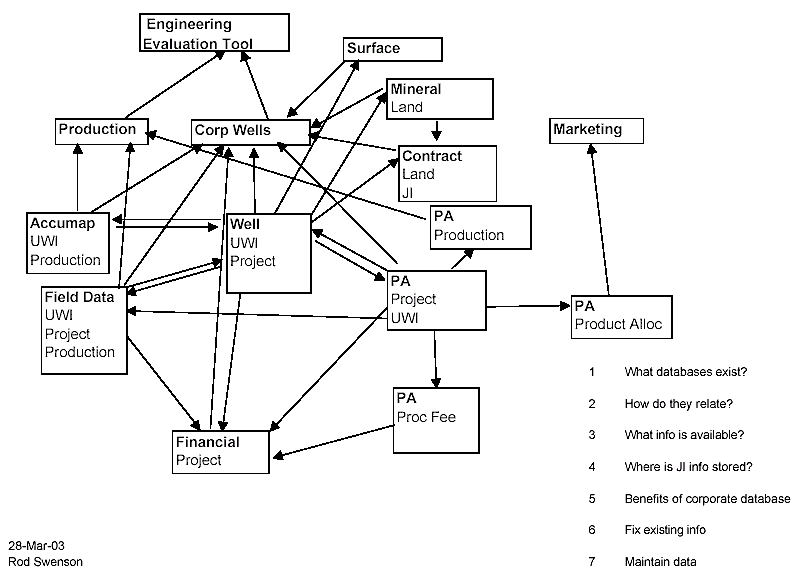
The Early Morning Planning Group believes there is interest in dedicating two more sessions so that Rod can continue with the same topic and address special interests. Tentative dates are April 22 and May 27, 2003. To be confirmed closer to these dates.
February 2003
THE C2C TASK FORCE & "NEW SKILLS FOR RESOLVING DISPUTES"Resolving disputes through negotiation is something we do every day, at work and at home. The process and communication skills used by mediators in helping others resolve disputes can be learned and applied by each of us to improve our own effectiveness in negotiations.
JIM WILLSON (lawyer, mediator, arbitrator, instructor and coach) will review the four-stage interest based negotiation/mediation model and demonstrate the use of these communication skills in a simulated mediation with representatives (PAT FORREST - PJVA Rep and GEORGE GREEN - CAPLA Rep) from the COMPANY TO COMPANY (C2C) APPROPRIATE DISPUTE RESOLUTION TASK FORCE.
Join us for an entertaining and informative morning session. The C2C TASK FORCE is here to promote some ideas of how disputes may be avoided or resolved at an early stage before they develop into overwhelming problems. We promise to leave you with at least one new skill to try out on your co-workers and partners (and even your family).
November 2002
ISSUES RE PROCESSING AGREEMENTS- Do we really need separate Gas Processing and Gas Transportation agreements
- Should processing agreements be with the well operator on behalf of the well owners, or with individual owners?
- Has anyone ever tried to make the LIFO (last in first out) priority provision work? What about joint production from the wells?
- Standard Terms and Conditions Task Force - what are they doing?
- OTHER PROCESSING ISSUES from the attendees - Discussion
October 2002
- VIPER - Volumetric and Infrastructure Petroleum Information Registry - update
- Analysis and Measurement - The reality of Operator and Producer compliance at JV facilities
- A&D - Understanding the responsibilities for paying JV billings after closing
- Affiliates - How to correctly deal with them (capacity, priorities, ROFR's, etc.)
- Audit Principles - continuation of November discussion - to discuss standards, scheduling, responses to exceptions and improved methods of conclusion
- One year later - a look at Statute of Limitations or Power Deregulation or both
May 2002
PANEL DISCUSSION OF JOINT VENTURE HOT TOPICSJoin us for a panel discussion of shared joint venture concerns
On the panel will be:
- Doug Phillips - Manager, Joint Ventures - Canadian 88 Energy
- Alan Harvie - Partner - MacLeod Dixon
- Cheryl Pritchard - Manager, Foothills Business Development - Keyspan Energy Canada Inc.
- Doug Sick - Joint Venture Representative - Talisman Energy
- John Kingsbury - Principal - Gas Processing Management Inc.
- JP-95 - Current interpretations in the industry (used well or abused?)
- Emulsion handling and water disposal fees - How should these fees be calculated to be fair to both Producer and Operator?
- Midstreamer and Producers Owners - Will marriage work or will we just be friends?
- Right to take in kind - Who decides; Processor, Well Operator or Working Interest Owner?
- Administration fees - What do you get for $250/w/m?
- CSO fees - When is it appropriate to charge to third party processors?
- Bring your own questions, concerns, or comments on any joint venture topic that you are looking for some input into.
April 2002
THE PETROLEUM REGISTRY OF ALBERTAFred Lavitt, Interoperability and Implementation Manager for the Registry (formerly known as VIPER) project on behalf of the Government of Alberta, will be joining us to lead a discussion on the implementation of the Registry process in our industry. The industry testing begins in April 2002 wi th full implementation scheduled for October 2002. This Registry project represents a significant amount of change for most companies. Will you be ready?
Fred will discuss:
- What is the Registry?
- What are the benefits to Industry?
- What are the "Hot Topics"?
- How could your company be impacted?
- What could the effect be on Joint Venture properties or roles?
March 2002
LIFE WITHOUT AN AGREEMENTJohn Stayura, of Tom Brown Resources Ltd. and co-author/co-instructor of the new PJVA CO&O course will be joining us to lead a discussion on a situation we have all encountered in our joint venture careers - conducting our joint business without an agreement in place, especially a CO&O agreement. John discussed:
- Key terms that are effected by the lack of an agreement
- Common law treatment of a facility with no agreement
- Alternatives to a signed CO&O agreement - pros and cons
- How enforceable is a draft agreement?
- What about service agreements (or lack thereof)?
February 2002
MIDSTREAM PROCESSING IN JOINTLY OWNED PLANTS- Sharing of processing revenue vs streaming of processing revenue
- Wellhead purchases or buy/sell arrangements for non-Owner production
- "Firm Pool" for processing within a joint venture plant
- Priority of processing for non-Owner gas
- Enlargements, or capital expenditures for non-Owner processing
January 2002
Custom User Audit GuidelinesThe Custom User Audit Committee, a subcommittee of the PASC Joint Venture Audit Committee (JVAC) and the Petroleum Joint Venture Association, has drafted Custom User Audit Guidelines currently being reviewed by PASC.
This project commenced by soliciting concerns surrounding Custom User audits within the industry, the results of which were published in the PASC and PJVA newsletters. Based on industry feedback, Guidelines for administering and conducting Custom User Audits were drafted, which we feel meet the requirements of industry today.
The Guidelines are divided into four sections; Protocol, Procedures, Confidentiality and Resolution. All sections, except for Procedures, are quite unique to Custom User audits and a summary of each will be presented by Kathleen Grey, audit consultant; Bill Harvey, Council - JV Contracts for Chevron Canada Resources and Noel Smyth, Manager of Operations Services for Keyspan Energy Canada, before opening the floor for discussion.
November 2001
SETTLING ACCOUNTING ISSUES- MATERIALITY
- What is material enough to require a settlement?
- What is material enough to require a rework of previous product allocation?
- Audit protocol
- What is material enough to require a rework of previous product allocation?
- PRECISE ACCOUNTING vs SETTLEMENT
- Does every error have to be precisely corrected? - settlement vs rework.
- How far back should we correct? - legal and moral obligations.
- Production accounting reworks - settlement by cash or by volume
- How far back should we correct? - legal and moral obligations.
- BENEFICIARIES OF SETTLEMENTS
- How do all past owners/parties receive benefit (cost)?
- Operator's obligations to allocate settlements? - current or past owners
- Other affected parties - royalty owners, the Crown
- Operator's obligations to allocate settlements? - current or past owners
- RIGHT TO PROTEST BILLS
- Withholding payment
- Right to offset
- Agreement provisions
- Right to offset
Assistance: Lynda MacNeill, PanCanadian Energy
September 2001
INDUSTRY EDUCATION PROGRAMS - ARE WE SERVING YOUR NEEDS?- To start off this year, we will be looking at education programs offered by the various industry associations. There will be representatives from some or all of the following associations:
- Petroleum Accountants Society of Canada (PASC)
- Canadian Association of Petroleum Production Accounting (CAPPA)
- Canadian Association of Petroleum Landmen (CAPL)
- Canadian Association of Petroleum Land Administration (CAPLA)
- and of course, PJVA.
- Canadian Association of Petroleum Production Accounting (CAPPA)
The last half of the session will be more interactive. Now that you know what is available, tell us what we are doing well and what we can do differently:
- What are you looking for in education opportunities that will help you do your job better?
- Subject matter
- Length (how many days?), duration (how many hours/day?)
- Class size
- Type of instructor (volunteer or professional?)
- Type of notes/handouts
- Location
- Cost
- Credit/Non-credit
May 30, 2001
Payout AccountsJoining us this month is Jim McLean. Jim is the Land Manager at Chevron Canada Resources and the principal draftsman of the 1990 CAPL Operating Procedure, the 1997 CAPL Farmout & Royalty Procedure, the 2000 CAPL Property Transfer Procedure and the pending update to the 1990 CAPL Operating Procedure.
He will be presenting an overview of payout mechanisms under farmout agreements and the CAPL Operating Procedure including:
- traditional cost recovery mechanisms and their deficiencies;
- volume based alternative; and
- status of update work on the 1990 CAPL Operating Procedure respecting the production penalty mechanism
April 25, 2001
Energy Utilities Board's Appropriate Dispute Resolution (ADR) InitiativeJoining us this month will be Bill Remmer from the EUB and Dave Savage from BXL Energy to speak on the new EUB dispute resolution initiative. Both of these people were involved from the beginning on the committee which guided the formation of the process now used by the EUB. Informational Letter 2001-1 titled Appropriate Dispute Resolution (ADR) Program and Guidelines for Energy Industry Disputes was issued January 8, 2001. This regulatory document formalizes the use of ADR and explains the Board's expectations and requirements.
The goals of the EUB ADR program include:
- improved landowner-industry relations in the interest of all Albertans
- better use of the EUB's and stakeholders' time and other resources
- more face-to-face discussions between affected landowners and company decision-makers, leading to local solutions to local problems
- enhanced efficiencies in the effort to meet the needs of stakeholders in the electricity and upstream oil and gas sectors
- increased resolution of industry-to-industry disputes without an EUB hearing
- a more effective and efficient hearing, if one is necessary.
March 2001
This month we are trying something new!There will be a panel of JV professionals who will discuss (and encourage discussion of) various Joint Venture issues of their choosing and your choosing. What we hope to accomplish is to have a quick look at several topics that will not fill a whole session but that do deserve some air time. Some of the issues that have been put forward for discussion:
- Common Stream fees, or Alliance fees proposed by some processors
- Differential processing fees for Owners vs. non-Owners (eg. 15% vs 20% ROR)
- What can be done to increase the confidence level of Operators and non-Operators that the facility $ values they are reporting to their insurance company accurately reflect the facility's true replacement cost?
- How to optimize the process so that a non-Operator can take over suspended Unit wells for uphole potential? What obligations (if any) does the Operator have to share technical information with the uphole Owners as to the condition of the wellbore and the lease?
- How are the model PJVA agreements working in the industry?
Facilitated by: Pat Forrest, Northern Cross Resource Management Inc.
- Panel:
- Robert Foster, Anderson Exploration Ltd.
- Storm Purdy, ATCO Midstream Ltd. (and Vice President, PJVA)
- John Stayura, Joint Venture Management Inc.
- Storm Purdy, ATCO Midstream Ltd. (and Vice President, PJVA)
February 28, 2001
13th MONTH ADJUSTMENTS - IS THERE A BETTER WAY?- PROBLEMS WITH THE CURRENT WAY
- Timeliness of adjustments - within three months of the end of the year?
- Missed costs - non-capital AFE's
- Retroactive processing fee adjustments - ownership changes
- Changes of Operator during the year
- Are retroactive adjustments fair and equitable?
- A PROPOSAL FOR A BETTER WAY
- Charge Operating Costs fee to throughput
- Adjust forward, not backwards
- The Rimbey and Strachan experience - a three year rolling average
- Relative size of adjustment
- Throughput adjustments should not apply to minor gathering lines
- REVISION OF CURRENT AGREEMENT PROVISIONS
- Need for an Industry Task Force to develop provisions
- Revise individual agreements, or by Industry Agreement?
Assistance: Blaine Clarke and Noel Smyth, Keyspan Energy Canada
January 31, 2001
Limitations Task Force and the resulting Industry Agreement regarding the Limitation ActPlease note this topic has been changed from the previous notices. A discussion on Payout Accounts has been moved to May.
- On March 1, 2001, the new Limitation Act comes fully into effect in Alberta. Under the new Act, all actions must be commenced within two years of when the claimant knew or ought to have known of its claim.
- Industry standard auditing procedures and industry agreements currently establish a process for the conduct of audits which might result in claims becoming statute-barred before the audit occurs.
- In response to an industry survey, PASC formed a Limitations Act Task Force with a number of individuals presenting a number of key oil and gas companies and certain industry associations including PASC, CAPL, CAPLA and PJVA to find an industry wide solution to the limitation problem.
- Jay Park, a director of PASC and a lawyer with Macleod Dixon, will be on hand to present the results of the Task Force and the resulting Industry Agreement. Additional information on this initiative can also be found on the PASC website (www.petroleumaccountants.com) or PJVA website (www.pjva.ca)
- How is your company going to handle this situation? The agreement must be signed by February 15, 2001 in order to effectively amend the tens of thousands of agreements that require amending.
- Come share your questions, concerns and observations.
November 29, 2000
Possible Impacts of Power Deregulation on the Joint Account- This topic was addressed at the October PJVA luncheon and is still generating a lot of discussion.
- What does the CO&O say about purchasing power for facilities? What approvals are required, if any?
- Do we ride the wave of prices and pass on what we are billed or do we become brokers where we buy and sell as required?
- If we become brokers do we pass on the ups and downs to partners? Or do we take the profits and losses?
- Do we do an equalization at the end of the year for our cost of power? Maybe we need to set a benchmark for the cost of power which companies profit from if they are below and absorb the cost if they are above.
- What standards, if any, needs to be addressed/implemented by the industry to avoid possible problems down the road (at audit time, for example)?
- How is your company going to handle this new situation?
- Come to share your questions, concerns and observations.
- What does the CO&O say about purchasing power for facilities? What approvals are required, if any?
October 25, 2000
Preliminary Results of CAPP Road Use Task Force Report- John Winton of Husky (Renaissance) and Don Snowdon of Northstar are representatives from the task force and both have 20 years experience as surface landmen. They have been responsible for numerous road use negotiations. They will be at the meeting to present some preliminary results and to lead the discussion
- Find out their recommendations and findings
- Share your questions, concerns and observations